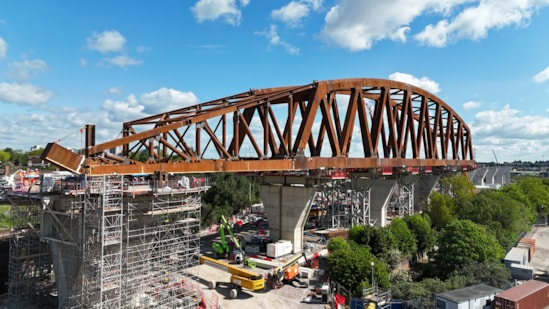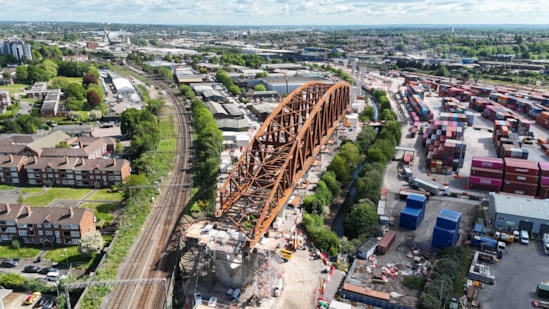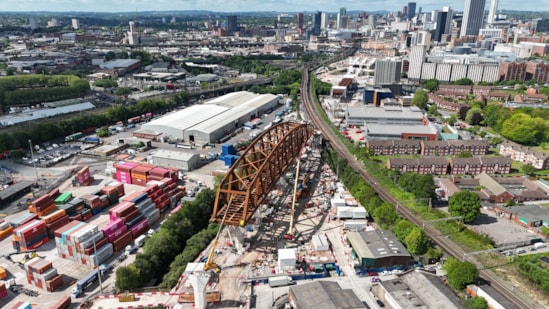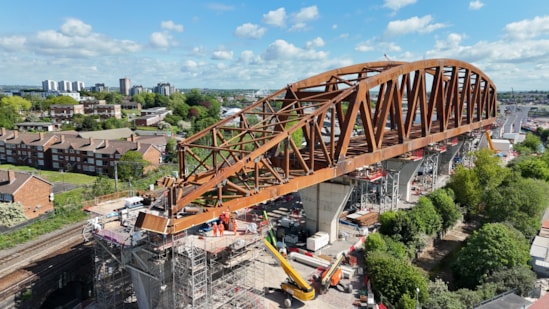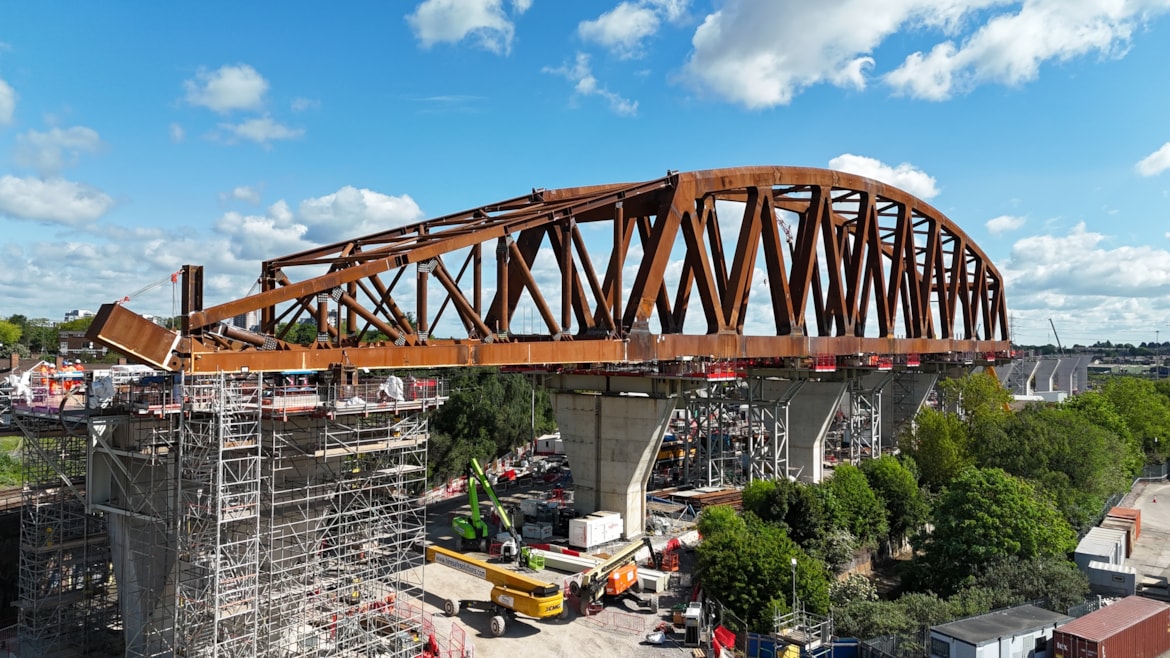
HS2 engineers have finished building Curzon 2 - the tallest bridge on the new high-speed network – and final checks are underway ahead of its launch over the Cross City railway line, just outside Birmingham city centre.
The engineering feat marks another huge milestone for the high-speed rail project and shows the significant progress being made on the 140-mile railway between central London and the West Midlands.
The intricately designed structure is part of the Curzon approaches, a network of five viaducts that form the final mile of the journey towards HS2’s Curzon Street Station.
The bridge’s striking 24-metre-high truss is composed of 670 individual steel sections that were welded to form the triangular-shaped units. It is built using weathering steel, which will naturally darken in colour over time.
The 4,200-tonne bridge will be moved over three launch phases and is expected to reach its final position on Friday, 5th June. When complete, the structure will rest over an existing Victorian railway viaduct, which itself stands 17-metres high.
Once locked in place, the tip of the bridge’s arched truss will reach over 40-metres high – the equivalent of a 10-storey building - creating a stunning new addition to the Birmingham skyline.
Greg Sugden, HS2’s Head of Delivery for the Curzon approaches, said:
“Curzon 2 is designed to reflect Birmingham’s proud industrial heritage, and it will soon become a recognisable landmark on the cityscape – just like the Rotunda and the BT Tower.
“I’m immensely proud of the civil engineers, welders and apprentices that have each played a part in its construction and we stand ready for the final challenge – launching the bridge over the adjacent railway line.”
A team of 250 engineers, working for HS2’s construction partner Balfour Beatty VINCI, have spent three years working on the super-structure.
In 2023, the team installed 32 permanent piles, each around 30 metres deep, to strengthen the ground, ahead of construction works starting. In 2024, the bridge’s 150-metre-long deck was built on top of the seven piers of the adjacent Curzon 1 viaduct, with over 500 individual parts lifted by crane. Once in place, the team began the enormous task of assembling the truss using 4,200 tonnes of steel.
The heavily constrained construction site, sandwiched between the River Rea and the existing rail network, added to the complexity of the build. Cranes weighing up to 650-tonnes were used to lift the steel segments, ready for the team of welders who worked at height, day and night, inside fabricated boxes to shield the welding works from high winds and adverse weather conditions.
Now complete, the entire deck and truss structure will be slid 180 metres – as part of a three-phase operation - using a jacking system. Once in place, it will rest upon four concrete piers – two either side of the Birmingham – Lichfield railway line.
Onder Akin, Senior Project Manager for Balfour Beatty VINCI, who has led the complex civil engineering programme, said:
“This has been an incredible challenge and I’m extremely proud of the team who worked around the clock, in all weather conditions, to complete this magnificent structure.
“We are now preparing for the final stages, when the 4,200-tonne steel truss will be moved into position using high-precision hydraulic strand jacks. The structure will slide carefully into place over temporary bearings in a controlled operation.”
HS2 and BBV have worked closely with Network Rail and West Midlands Trains to plan for the bridge launch, ensuring disruption is kept to a minimum for rail users.
In the first stage of the operation, Curzon 2 will be pushed forward 50 metres to the boundary of the railway line. These works will take place at night to avoid any impact on passenger services.
The second stage will require a short closure of the Cross City line, between Birmingham New Street and Lichfield Trent Valley, as the viaduct is pushed over twin railway tracks – a distance of 93 metres. The closure will be in place from Friday 29th May – Sunday 31st May 2026.
The final stage of the operation – a 37-metre push – will ensure the structure is docked and securely locked into position on all four piers.
Significant progress is being made on the five connected viaducts that form the Curzon approaches – marking out the route of the railway towards the new terminus station at Curzon Street.
- Duddeston Junction – the first stage of a six-phase launch was successfully completed on 2-4 May 2026. The second launch will take place later this year.
- Curzon 1 – When Curzon 2 launches, the next phase of works on Curzon 1 will commence (Curzon 2 is currently resting on the piers of Curzon 1).
- Curzon 2 - Structurally complete and ready for launch.
- Lawley Middleway– Phase one launch (112-metre-long-section) successfully completed in August 2025. Phases two and three are currently underway. Weighing in 510 and 656 tonnes respectively, the extended sections of the viaduct are currently being assembled and welded in situ.
- Curzon 3 - which links onto the platforms of Curzon Street Station. The concrete deck works at the station end are now complete. Later this year, construction over Digbeth canal will begin, following completion of the steel piers either side of the canal.
While good progress is being made, there is still a vast amount of work to do across the 140-mile route between London and Birmingham. Mark Wild, HS2 Ltd Chief Executive, is leading a comprehensive reset of the project to ensure the remainder of the route is delivered as efficiently as possible and for the lowest reasonable cost.
Passengers affected by the Cross City line closure from Friday 29 until Sunday 31 May are encouraged to plan their journey and check before they travel at www.nationalrail.co.uk and with West Midlands Railway at www.wmr.uk.
ENDS