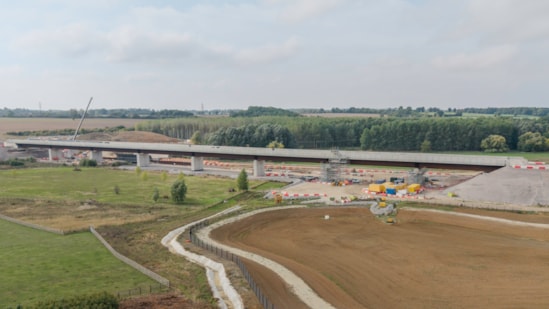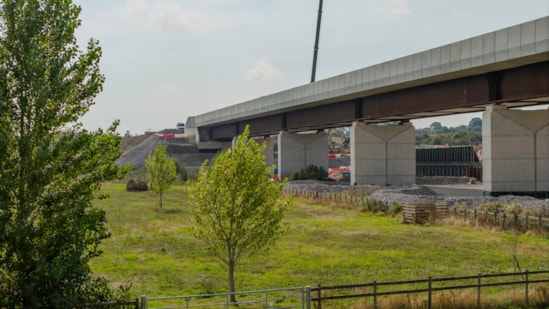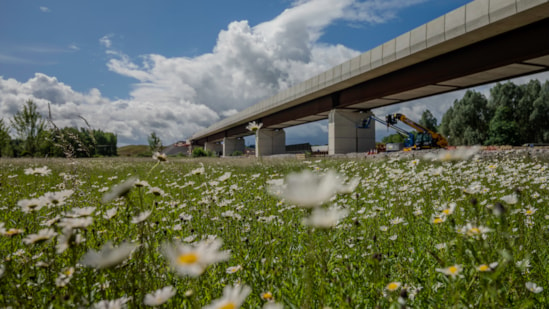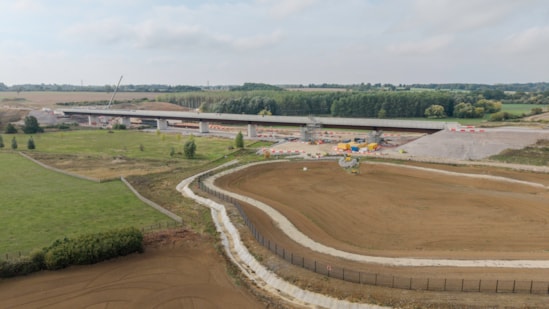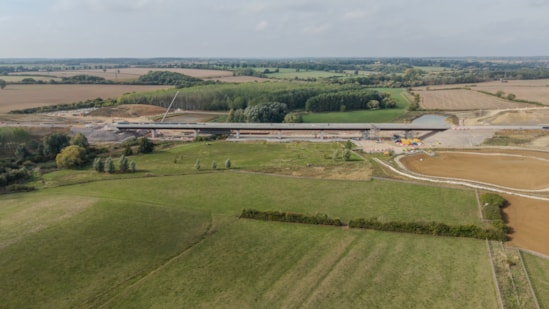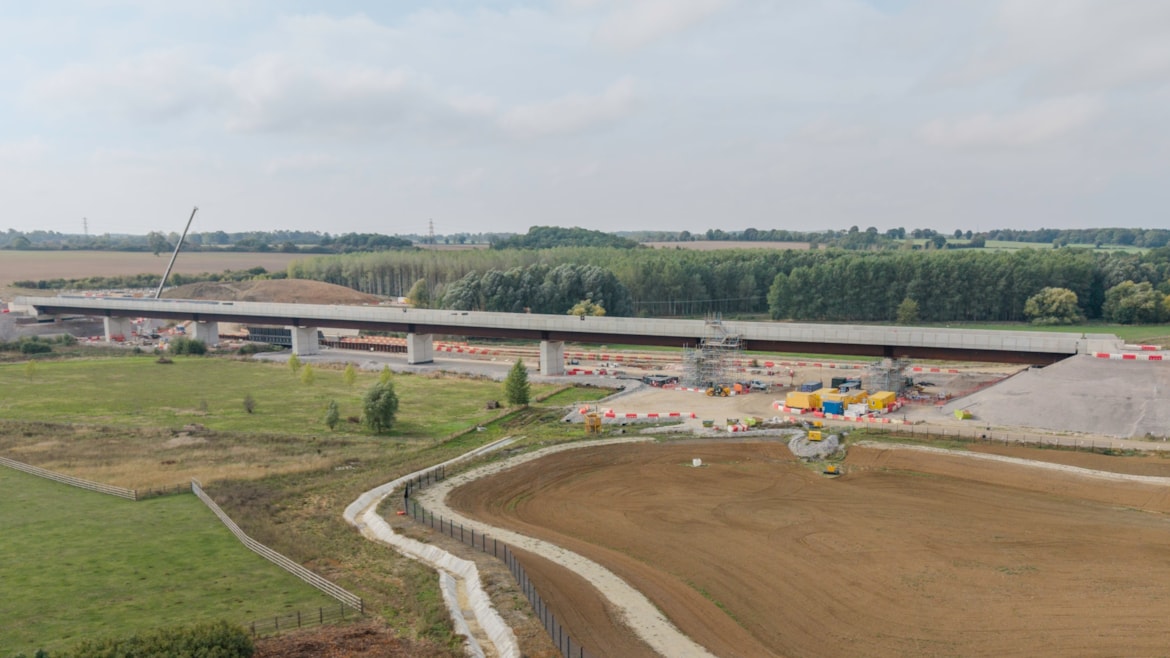
Engineers working on the HS2 project have put the finishing touches to a major viaduct that will carry high-speed trains across a floodplain of the River Great Ouse near Brackley.
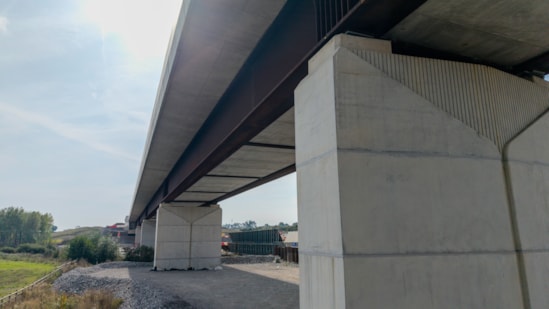
Set low in the landscape to the east of the town, the 320-metre-long Westbury viaduct was built using an unusual ‘double composite’ approach inspired by recent viaducts on the French TGV network, which uses less carbon-intensive concrete and steel than a more traditional design.
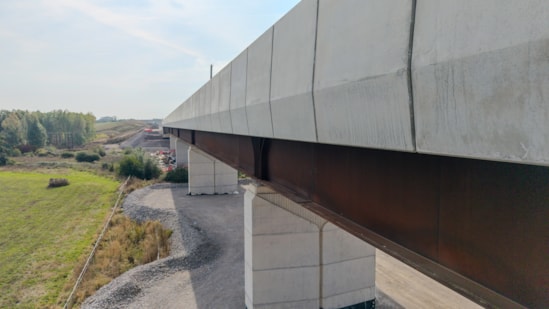
Instead of a purely concrete span, or a steel beam supporting a concrete deck, the double composite approach uses a layer of reinforced concrete above and below the steel beam, creating a more-efficient box-beam.
The steel beams – which alone weigh 2,695 tonnes - were assembled on the north abutment before being slid into place between March and October 2024.
During the slide, special pads covered in a non-stick coating – similar to the surface of a frying pan - were used to minimise friction between the deck and the temporary steel bearings on top of each of the concrete piers.
With the steel beams in place, a travelling formwork was used to cast the concrete deck. This was done in 42-metre-long sections, with the formwork pulled forward each time to allow the next section to be cast. With the deck complete, the prefabricated parapets along the edges were then lifted into position and secured into place.

HS2 Ltd’s Senior Project Manager, Paul Cooper said:
“It’s been amazing to watch Westbury viaduct come together over the last few years and I’d like to thank everyone involved in getting this incredible structure over the finishing line.
“This section of the railway is now really starting to come together, and with the viaduct complete, our focus will turn to completing the earthworks and other nearby structures.”
Westbury is the longest viaduct in the Brackley area and one of fifteen being built by HS2 Ltd’s main works contractor, EKFB, who are responsible for the central section of the HS2 project. They are a team made up of Eiffage, Kier, Ferrovial Construction and BAM Nuttall.
With construction now finished, the hardstanding surface beneath the viaduct, which was put in place to support heavy equipment, will be removed and the landscaping completed.
Strong progress is also being made nearby structures such as the Turweston green bridge, which was completed in April and the realignment of the nearby A43, which was completed in July.

EKFB Project Sub Agent, Arman Yarali, said:
"It’s fantastic to see Westbury Viaduct structurally complete.
"This viaduct showcases the innovation, technical expertise and collaboration behind the build. Its double composite design has created a lighter, more efficient structure that uses less concrete. As the first of five viaducts to be completed, that are designed and built in this way, this milestone demonstrates EKFB's ability to deliver complex engineering solutions with both sustainability and design in mind.
"Thank you to everyone involved in delivering this structure safely. This achievement would not have been possible without the expertise of our supply chain partners, including Eiffage Metal, who led the manufacture and installation of the beams, and Infrasolutions Ltd., whose specialist deck finishing works were key to bringing the structure to completion."
The last few months has also seen significant progress at HS2’s other major viaducts, including the key structures that cross the M42 and M6 outside Birmingham and the viaducts taking the railway into the city’s new Curzon Street.
In total, HS2 is building more than 500 bridging structures – ranging from small road bridges to the record-breaking Colne Valley Viaduct.
Once complete, the project will transform journeys between London and Birmingham while freeing up space on the existing West Coast Main Line for more freight and local services.