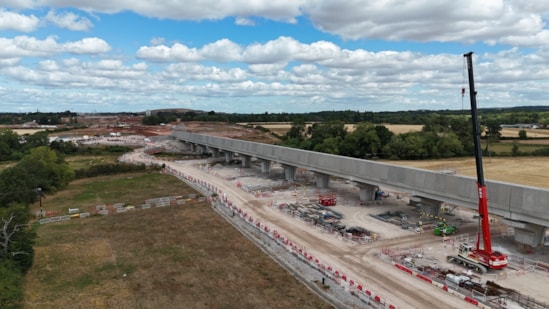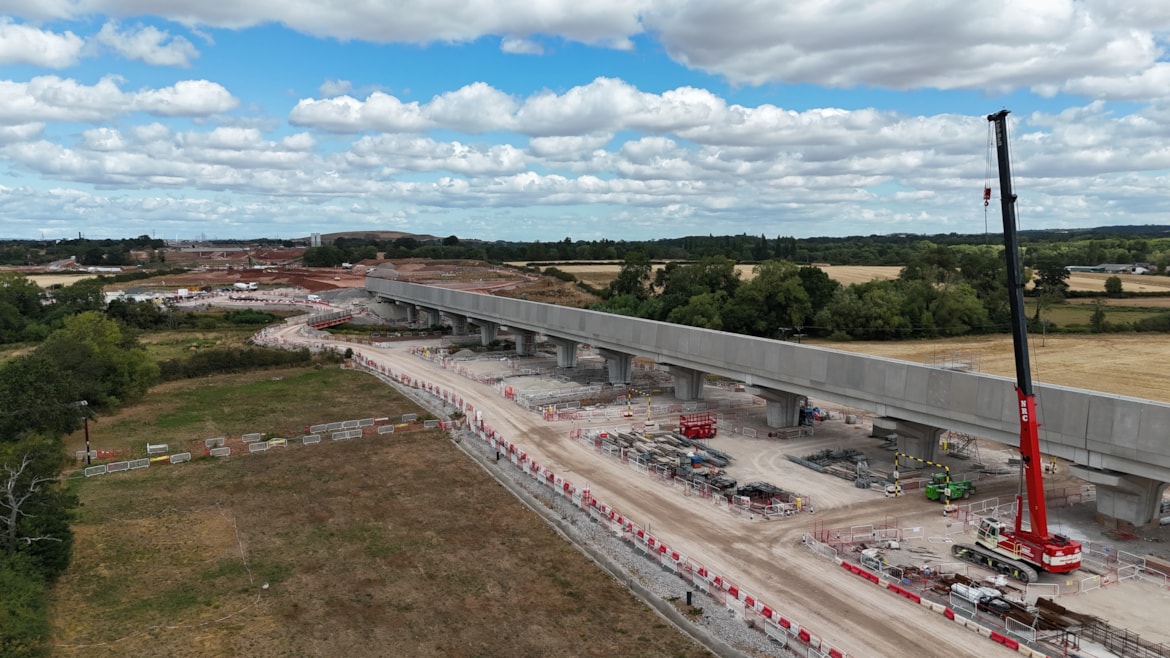
HS2 engineers have completed three major structures on the southern approach to Interchange station, illustrating further progress on the West Midlands section of Britain’s new railway.
The trio of viaducts - Balsall Common, Marsh Farm and River Blythe - are all within the Solihull metropolitan borough.
In the coming days, engineers working for HS2’s construction partner, Balfour Beatty VINCI, will install the final parapets on the River Blythe Viaduct – the largest of the three bridges that carry the high-speed railway through Solihull, and the closest to Interchange Station – approximately 1.5 miles away.
Marsh Farm Viaduct was the first of these neighbouring structures to reach completion in summer 2025. The main structure of Balsall Common Viaduct was finished earlier this year, and all 304 parapets will be installed by spring 2027.
Doug Barnett, HS2 Ltd’s senior project manager said:
“Our engineering teams are making fantastic progress on the Interchange Station approach, and it’s a significant achievement that all three viaducts in the Solihull borough are now structurally complete.
“The design and landscaping solutions were of upmost importance to local residents, and we worked extremely hard to get that right.”
River Blythe Viaduct
Both the River Blythe Viaduct and Balsall Common Viaduct are ‘Key Design Elements’ (KDEs), which means their size, proximity to communities, or location within sensitive areas, marked them out as significant. Local communities therefore helped to influence their design.
As the River Blythe is designated as a Site of Special Scientific Interest (SSSI), the 495-metre-long viaduct was built with this in mind. The low-lying 12-metre-high structure skims the landscape as it crosses the river, the floodplain and Meriden Road near Hampton in Arden.
The deck is supported by two abutments and 19 concrete piers with Y-shaped splits to reduce the volume of concrete and enhance the aesthetic appeal. Local communities opted for larger-sized polished parapets to one side of the structure and were consulted on the tree planting that will help to blend the viaduct into the landscape.
The space under the viaduct will allow safe passage for a range of species, including dispersal routes for badgers, bats, birds, fish, great crested newts, otters and water voles. The design will also allow views through and around the viaduct, and the polished concrete acoustic parapets will visually reduce the mass of the structure, as well as minimising noise for local residents.
Now structurally complete, engineers will carry out the finishing touches, adding acoustic barriers and conducting final water proofing works.
Marsh Farm Viaduct
Two and a half miles south is the smallest of the three structures – Marsh Farm Viaduct, which carries the HS2 main line over Bayleys Brook and surrounding marshland.
Standing just five-metres above ground, the 145-metre-long viaduct is currently being used as a haul road to support construction of the adjacent embankments and cuttings, while reducing the number of lorries on local roads.
Balsall Common Viaduct
Just outside of the residential area of Balsall Common village stands the 430-metre-long Balsall Common Viaduct. Constructed to north-east of the existing Network Rail line, the eight-metre-high viaduct crosses Station Road, Truggist Lane, Bayleys Brook, Heart of England Way walk and the associated floodplain.
Now complete, engineers will begin installing the parapets, which were chosen by the local community. A public vote determined that the parapets would be designed with a polished finish to reflect the sky and surrounding vegetation, and that the viaduct would feature a unique weave motif in a nod to the area’s history of textile production.
Matthew Parkes, Construction Manager at Balfour Beatty VINCI said:
“The structural completion of these viaducts is a huge another achievement for Balfour Beatty VINCI and its supply chain partners. All three viaducts span a range of diverse landscapes and environments, including wetlands, foodplains, SSSIs and water courses – making this achievement even more remarkable.
“Every effort has been made to protect these precious spaces and habitats. The realignment of Bayleys Brook is just one example of how the team has delivered on this commitment, where engineers carefully diverted a 150-metre section of the brook to allow Balsall Common Viaduct to pass over the top.”
The HS2 route has more than 500 bridging structures – including over 50 major viaducts which will stretch for a combined total of 15 kilometres (9 miles) across valleys, rivers, roads and flood plains.
When complete, Britain’s new high-speed railway will create quicker and more reliable journeys, driving economic growth while crucially freeing up space for more local trains on the most congested part of the West Coast Main Line.
From Interchange station, passengers will be able to travel to London Euston and HS2’s new superhub station Old Oak Common, which will be directly linked to over 100 locations in the UK.